Showing posts with label the human condition. Show all posts

30 June 2009

Does secularism fuck you up? part 3

Dad,
You write: "You seem to be saying that inner states (subjective experiences) are dependent on brain states for their “existence”. Let’s call brain states A (as seen from the third person perspective) and inner states B (as seen from the first person perspective). It can be easily shown that changes in A bring about changes in B. Is the opposite true? Do changes in B bring about changes in A?"
I don't think the two should be thought of as separate or as having effects on one another. Inner states ARE brain states, and vice versa. They are the same ongoing process. Accepting this is hard because we have so much knowledge (subjective experience) about the inner states of our own brain, and so little knowledge about the inner states of brains in general scientific terms. But brains feel; they can be in states of compassion or angst or anger or trust and so on. It seems absurd to us that a physical object could have deep thoughts and feelings only because of our ignorance about the hyper-astronomical complexity of the brain.

Changes in our inner states are changes in our brain states. Meditation, for instance, seems to involve a profound reorganization of the frontal lobes, which you experience in enormous detail if you engage in meditation. This is what is meant by neuroplasticity - even in adult life the brain re-organizes; that's how we learn and change. Even the memory of what happened a moment ago requires plasticity; the brain re-organizing its synaptic connections to incorporate the new memory.

I think the deep inner brain states you emphasize in your work (contemplation, meditation, compassion, silence, unity, gratitude, trust) are challenging because they involve much more profound re-organization of the brain in which they occur. How can such re-organization be facilitated? Under what conditions is a brain most capable of deep change? I think answering these questions has always required and will continue to require deep human understanding of our brains as persons with bodies and social environments and rich lived experiences.


Part 1, part 2

28 June 2009

Does secularism fuck you up? part 2

Dad,
You write: "Do you mean that “feelings of meaninglessness” and “feelings of compassion” are nothing other than electrochemical activity? Can we fully understand “feelings of meaninglessness” and “feelings of compassion” by just grasping what is going on in the brain, “a network of neurons”?".. Human history reveals that techniques for changing inner (subjective) states [contemplation, meditaion, compassion] have played a major role in the evolution of culture. Are these techniques now something of the past? What is the next step in the evolution of culture? Where are we going?"
The key, I think, is in the phrase "nothing other than". It implies a destructive reductionism. But brain states are hyper-astronomical in their complexity and profoundly sublime and beautiful in their dynamics. Neuroscience does not reduce rich inner states to simple things - it shows that rich inner states are astonishingly complex processes in the brain. That's what I meant when I said "inner states are brain states, no more no less". The phrase "by just grasping what's going on in the brain" similarly suggests that such understanding is readily available. It's not: we are nowhere near a good understanding of the brain. We don't even, as you point out, understand how snails learn to chew, much less the feelings they experience as they learn.

An understanding of feelings of meaninglessness or compassion would be utterly incomplete without understanding brains as persons with deep relationships to other persons, to their history, to culture and language, and to his or her subjective experience. We know very little about how to relate brains to other brains, to their upbringing, or to their inner life. We do nevertheless know that inner states are brain states; that they can be transformed or turned off by altering the state of the brain. As far as I'm concerned this doesn't degrade subjective experience, or reduce its significance or complexity, quite the opposite. However, I do very much think that our cultural transition from souls to brains will be a profound challenge, a real adventure. Neuroscience only really got going in the 1990s, and we will learn much much more in the years ahead. Inner states will no longer be completely subjective or private.

The challenge in all this is to avoid a nihilism that exists at the core. Descartes failed to do so when he concluded that animals, lacking souls, were "just machines" that could not have feelings, and proceeded to carry out vivisections and experiments of the most hellish kind on dogs and other species. This nihilism says that if all our rich inner states are "nothing but" brain states, then they are meaningless, worthless, and can be abused. This nihilist temptation is amplified by the shortcuts of consumerism and new technology, and by the sheer complexity of the neuroscientific world-view that is emerging. Therefore, as we travel through this cultural transition, it will be more important than ever to emphasise the reality and importance of deep inner states, and the role of contemplation, meditation, compassion, silence, unity, gratitude and trust.


Part 1, part 3

27 June 2009

Does secularism fuck you up?

Dad,

I'm not sure a secular neuroscience necessarily leads to a spiritually impoverished reductionism with no interest in the deeper side of life. Some people worry that the scientific method reduces a rich inner life to "just another brain state" but among neuroscientists there's usually considerable awe at the enormous complexity of those brain states, and how very little we know about them. There is also an interest in deep inner states such as meditation - see this video for the interesting history of that side of neuroscience http://www.bu.edu/phpbin/buniverse/videos/view/?id=247

I think a secular world-view will however change our understanding of ourselves and our inner lives profoundly; much much MUCH more than secularists realize or are willing to admit. Thoughts, feelings, decision-making, values, personality traits, morality, existential judgements, love and fear will no longer seem to inhabit a distinctly mental realm, but will be described neuroscientifically in immense detail. I don't think the terms will go away: we all have a 'theory of mind'; we can all take the 'intentional stance'. But as neuroscience progresses people will come to accept that they are brains; that their inner states are brain states, no more no less. My opinion is that this will lead to (1) widespread moral relativism, not in the sense of anarchy or cruelty but if moral values are well-defined, vividly visualized brain states explained in high-school biology textbooks then nothing IS right or wrong, it just SEEMS right or wrong; (2) widespread adoption of techniques to change the brain, driven by and driving neuroscientific advances and moral relativism; and (3) a situation where a scientific understanding of people in general and yourself in particular will be extremely valuable, not displacing subjective forms of knowledge but rather enhancing and being enhanced by them.

Where does this leave spiritual experience and the search for deeper meaning beyond the material? I don't know. Maybe, as traditional organized religion gradually acquires the status of myth and make-belief not suitable for a scientifically aware 21st century person, civilization will see an even greater hunger for transcendence and religious conviction. Maybe not. Maybe you can fill that hunger with ever larger TV screens and new technology, maybe not. Maybe we will turn our eyes toward a medical and technological defeat of the aging process and explore the stars together.


Part 2, part 3

30 January 2009

Dissociation of sensibility

Beh. Just got a blue screen of death on my ailing lab-PC. Now it won't start. Gotta get it replaced.

Sitting in the lab, working lazily and listening to an old Philoctetes Center classic: Origin of Norms, with Gerald Edelman among others.

Friend talked yesterday about the dangerous spiral of depression->unemployment->worsening economy->more unemployment->more depression that goes largely untreated in many developing countries. Makes sense. As I've said before, I'm finding it difficult to see how the Anglo-Saxon world, with its small population, maintains such a lead in living standards.

Computer still won't start. Dammit.

I read the transcript for the dopamine video at a creative writing session a few days ago and someone said "You think that's really how it works?". She didn't mean was I correct about the details but did I think desire and motivation was all about chemistry. I said there was no question about it. She talked about a "part of us that doesn't want it to be like that". I wonder. What is lost when we think of the mind as a machine? Magic? The ghost or soul? For some, a sense of wonder and mystery. Control. Because, remember, most people are not neuroscientists.

I talked to a guy on a bus once, he was an English student and on hearing that I studied neuroscience he said "I don't know anything about the brain". I told him 'Yes you do, you have one!'. If only that were true. If only people were as knowledgeable about their brains as they are about their computers, cars, kitchens, feelings, children. If we could track the rise and fall of transmitter concentrations as we can track the rise and fall of sleepiness, hunger, lust, and see how they're related. A brain scan for every man, woman and child in Europe!

Computer still won't start. I understand we'll be getting a new one next week if all goes right.

You know, I realized the other day there's actually a pretty advanced MRI here at the university. Maybe I'll go sign up for an experiment and see if I can a few images of my brain.

11 November 2008

Aging

It's time for the fifth edition of Hourglass, a blog carnival about the biology of aging, hosted this time on Laura's blog: psique.

Those of us who study neuroscience know that there is no life after death. We are acutely aware of the delicate structure of consciousness. We know that even the agnostic creed "I don't know what will happen to me when I die" is as misguided as belief in a flat Earth. We know. I'm sorry to disappoint you but we really do know now. It is not a mystery. After death your mind shuts down, permanently.

Some of us are OK with this. Some of us point out that once we're dead we won't know it, so what's to fear? I am not one such person. I do not want to get old, and I do not want to die. I want to survive, and I want those I love to survive.

So I applaud the new generation of biogerontologists who want to extend life indefinitely. I applaud stem cell research, personalized medicine, nanotech, and blog carnevals about the biology of aging. Advances in medicine and medical technology continue to reduce blood-pressures, patch up hearts, extract cancers and extend life expectancy worldwide, and nothing could be more important. But only a transhumanist would be so naive as to feel safe that "somehow" science will save us; that technological progress is "likely" to save those of us who are alive today from annihilation. Know, please, that it is not just a handful of diseases threatening you; not just a few potential cancers eating away at your heart. What you're up against is entropy itself, and as soon as that first blood vessel pops you'll find out just how immature our medical science really is.

This is at the core of the iPlant. I know the plan is drastic, I know that. But I don't want to die, and you probably don't want to die, and it seems to me, just seems to me, that the only way we'll have a realistic hope of surviving is by commitment and organization on a mass scale. Everyone - two, four, maybe eight hours of monotonous research every week. That is how we have to approach the problems and possibilities highlighted in this Hourglass carneval. That's how we survive.

26 October 2008

Podoholic

When you're in the middle of a full-blown podcast addiction you don't listen primarily because you're interested, but in order to drown out the deafening silence. The emptiness of your own thoughts hurts and terrifies you, gives you the shakes. Sometimes the continuing flow of spoken words barely cover the neurotic, nihilistic whirlpool, but ultimately the podcasts are slightly more dopaminergic - or "motivating" as we used to say back in the day - than the solitary confinement of your own thoughts. So you keep on listening, religiously. You're an information-junkie, and your drug of choice is the spoken word. The iTunes Store is your pusher and the BBC is a meth lab.

Every now and then, however, you stumble across something of extraordinary value. You're struck by delightful surprise as the words pouring into your ears suddenly speak to you in more ways than you thought possible. For 30 minutes, or an hour, or two if you're as lucky as I was todya, you're engulfed; your poor addicted brain, so accutely sensitized to extracting value from those streaming headphones, is showered in relevance, meaning, expectation, monoamines, creative memory formation and retrieval. For that short duration of time, your personality grows and you're completely attentive.

Nowhere are such experiences more likely than in Professor Robert Harrison's Entitled Opinions (about Life and Literature), live from the Stanford campus. Seventy four hours of material, and counting. For the longest time I avoided the two-part program entitled The Rescurrection, despite an interesting earlier program with the same guest (Prof Thomas Sheehan) entitled The Historical Jesus (that show preceeds the monumental '1910', with Harrison's brother Thomas). I guess I thought The Rescurrection would be a dry mulling over the relation between culture, scripture and historical data (don't get me wrong: some episodes of Entitled Opinions, like the most recent one on the heart, are pretty lousy). It was anything but dull.

In the first hour, Sheehan, a professor of religion and a catholic, subjects the fundamentalist conception of Christ's resurrection to intense critizism, scrutinizing historical and biblical sources and presenting a strikingly unorthordox account of what really happened after Joshua's death on the cross, almost two milennia ago. In the second hour, Sheehan's scrutiny turns to Harrison's own latent catholisism. I won't try to recount this second hour, let's just say that topics include the profound absurdity of human existence and of Christian faith, and how the two connect and mirror eachother, as well as the limits of human understanding and the exceptionality of life. It's a great exchange, and I'll end with a quote from it:

"If there is not an agency of mystification, then somehow the sacrality even of these everyday things with which we live or eat - bread and wine - cannot assume, let's say the proper dignity, or absolute value associated with life, that they deserve." -Robert Harrison

Brainbeat

I'm standing on the vibrating, billowing hills of the tegmentum. Spherical and star-shaped cells; thin, sprawling nerve fibres; and thick, pulsating blood vessles stretch out in all directions. The ground is thick with receptors; twisting out of the bulging membranes like weeds and crystal algae.

The fluid is thick with glutamate; it envelops the cells, pulls on them, tears on their branches, and they willingly suck the salty fluid. Every few hundred milliseconds they trip eachother over the theshold, fluctuate, and generate a single, synchronized electrical impulse that shoots off along the medial forebrain bundle. It's a tonic, steady beat. Far away in the frontal lobe, that rhythm keeps the cortex active, keeps the thoughts alive, even in dreams.

234 151 dopamine neurons in this lobe. The cells are warm, depolarized, expectant; singing their neverending tonic song at three hertz, with more than usual synchrony. Pulse. Pulse. Pulse. Pulse. Pulse. Pulse. In the distance below, the dark substantia nigra cells warm up to the tune.

There. The steady rhythm is interrupted. The single expected nerve impulse is trippled. Pandemonium. The ground is trasformed as dopamine floods from neighbour to neighbour. Branches extend and reconnect. Entire cell bodies move as gap junctions synapse and pull cell membranes closer together. Again. Another tripplet. The background rhythm is up to four hertz now. Pulse. Pulse. Pulse pulse pulse. And then silence. A whole second passes before the tonic song is resumed and the cells begin to break rank and recover.

Something just happened.

02 September 2008

Transplant

C: i've got a question

L: yea?

C: we're able to, indeed encouraged to, donate organs. when it's possible to donate bits of the nervous system, what will people say? will we donate on not?

L: live donation or after death?

C: like donate your visual cortex to someone who lost sth in trauma. if your heart's about to go out or sth
not many deaths are CNS

L: thats the thing. brain doesnt stay fresh very long. it wouldnt be feasible for accidents and such. only if you're like: okay, lets turn of the machines now

C: no but for people dying in hospital bed
yea

L: i can imagine a lot of ppl having issues w that. personality and such

C: could you donate a whole brain? it might be easier actually ;)
of course

L: likely (the easier bit, not the could you bit)
i guess you could start w donating spinal cord. thats fairly unpersonal

C: or adrenal gland.

L: move up from there
yea
thats not nervous system tho

C: no?

L: ppl get thyroids implanted, no?

C: is to me

L: noooo

C: don't kno

L: its connected
but endocrine system, strictly speaking

C: is sex steroids and cortisol and all them tho!

L: yea yea. neuroendrocinology is a beautiful thing. a lot of those hormones are systemic in nature tho. bottom up control of brain, not nervous system, at least certainly not cns
i wonder if you could graft a piece of visual cortex into someone else's brain
connections and stuff

C: or frontal..

L: better than going blind maybe, but prob v difficult
or that..

23 August 2008

Pick and choose

I wrote a little while back that science does not describe every aspect of human existence.

Much that we are and see and do is infused with the unspeakable complexity of our brains, bodies and their embedding in the world. Many things cannot be defined in the language of science and some things can probably not be defined at all.

Meanwhile, there is superstition in the world, and it's important to get things right. We are error prone and biased, science is not.

14 August 2008

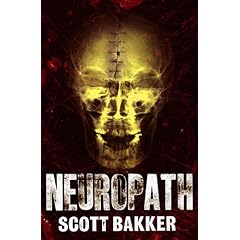
Neuropath


It's been a very long time since I read a book and then re-read it, highlighting large portions of every single chapter. I cannot recommend this book strongly enough.

Science has all but banished magic, God and souls from our thinking, yet we continue to insist on the importance of morality, responsibility, personhood, meaning and reason. Why? Because we feel their importance so directly. But feelings are neurons, and neurons have no selves. Nor, science continues to reveal, do brains.

This Argument (and I'm not saying I agree with it, but it should not be left unsaid) is summoned with truly exceptional depth, intensity and repetition in this thriller. Someone finally said it, said it all and more. Although occasionally storyline-light and over-American, the uncomparable interweaving of psychology, philosophy and ruthlessly reductionistic neuroscience into the plot makes this book an absolute must for anyone tired of and troubled by the wishful, superstitious and self-glorifying excuse of an existentialism we are fed with in this quasi-religious culture of ours (referred to as 'Disney World' throughout the book). What happens when the bullshit finally fails, when the scientific findings can no longer be ignored? This book rigorously pushes that question further than any text I've ever read.

Rest assured I will return with some quotes from the book once I've finished highlighting and shed some light on what it is I'm raving about. I certainly differ with Bakker here and there, particularly on the Spinozean slant on some of the later chapters, but at this point I just wanted to get the word out.

Adrian, I wish you everlasting beer, BBQ, pussy and sunshine for insisting I read this book.

19 July 2008

Existentialism on a Saturday morning


Wake to the sound of rain. Lazy sparks of last night keep me in bed with The Wire for another hour. But no matter, it's Saturday. In the lab the iMac won't start and I'm down to my last, barely functional array. Never mind, I write an email to dad instead. We've agreed that science doesn't describe every aspect of human existence. Now he asks how I decide which such non-scientific values, world views and systems of thought are stable, important, lucid and respectable, and which are myth, superstition or wishful thinking. Moreover, is it possible to modify man's biological nature without eliminating her sense of agency and freedom?
I write:
"I don't believe in choosing between materialism and existentialism - we need a world view that combines both; an existentialism that is compatible with the science of today and tomorrow. Our thinking about freedom, agency and responsibility must be compatible with what we know, and expect to know, about the formation of evaluations and decisions within the biological nervous system. It's hard to believe in meaning and morals if flesh and urges permeate every particle of our phenomenology, but the scientific description of mind and brain is real, and we must come to terms with it.

However, I do not think that such a 'scientific existentialism' must entail the elimination of free will. The iPlant, for instance, is designed to INCREASE the sense of agency and freedom in those lacking discipline. It requires, however, that we be comfortable with the realization that our desires, choices and our experience of meaning are intimately linked with the flow of dopamine in our brains.

I believe we need to fully identify with our bodies, brains and genes, and with our fellow human beings. As long as we can do that, we will be able to experience identity, agency, desire, love and meaning, and make use of biotechnology rather than recoil from it."

15 July 2008

Self-discipline induces misery in hypofrontal primates

METHODS
Up at 8. Low GI cereal, muesli or sandwich, cup of coffee and a glass of water. Stroll down to the lab. Work for 2-3 hours. Light lunch, preferably low GI sandwich with plenty of green in it, made the night before to save money. More coffee. Finish early, 4-5pm. Stroll back home and go for a run or to the gym. Leave plenty of time for cooking. Dinner before 8, not too much, not always meat, finish with fruit. In bed before 11.

DISCUSSION
If repeated over several days this protocol will convince a low-DA/hypofrontal brain (an ADD brain, an 'impulsive' brain) that its reproductive fitness is rapidly decreasing and that it must re-enter a high-DA state by any means necessary (e.g. bingeing, risk-taking, self-destruction, unrealistic thinking). To maintain the protocol, the low-DA/hypofrontal brain must introduce additional DA supplies (reinforcers) at strategic, well-defined points. The exercise component of the protocol will initially reduce DA, but may eventually become a DA supply in and of itself as stamina builds and endorphin signaling becomes more efficient. Other DA supplies may include novelty, exploration, sociability, intimacy, meditation, relaxation, construction and rewarding brain stimulation.

13 June 2008

Designer babies


This is a fantastic discussion about the morals of the new controversial reproductive technologies that are popping up (the debate starts with the story of a deaf couple that actively sought, and got, a deaf child). Fantastic because the moderator - Elliot Gerson - doesn't let the discussion stop, as is customary in these discussions, with the repeated luddite observation that "we experience moral concern with regards to [insert new technology here]". Gerson pushes the two debatants on whether we can really stop the use of reproductive technologies, whether it's anti-progress to try to stop them, whether it's the result of an underlying 'religious sensibility', whether it's comparable to eugenics, and makes repeated comparisons to other forms of 'hyper-parenting' and enhancement. AND he manages to do so not from the stupid, blue-sky standpoint of transhumanism, but as an intelligent, concerned humanist.

The discussion stresses the observation that many of the controversial technologies discussed are dual-use, i.e. something we, because of their enormous medical value, cannot effectively legislate against. It also repeatedly highlights the horror some people experience at the prospect of children being made indstruments of their parents desires, exemplified by fears that this would undermine unconditional parental love. Both these points are fully mirrored in the debate around the iPlant.

I'm increasingly curious about what factors predispose a person to consider biotechnology and enhancement ethically undesirable. What (other than general unfamiliarity with science and technology) makes someone prefer the flaws and limitations of a 'natural' body to an enhanced one? Since my own opinion on this question is so utterly polarized, a second question is also becoming increasingly important to me: what is the value of pain? What is the value of experiencing things the 'natural' way, of enduring and accepting the suffering that is often associated with being alive? In his brilliant 20 min talk entitled 'Ambivalence of the Posthuman Condition', Erik Davis suggests that the value is that it helps us to maintain a critical mind; it motivates us keep on seeking change as opposed to accepting status quo and seeking only what he calls "psychologically obvious goods".

I agree with Davis, but in my experience the pain of life is often more crippling than it is enabling, and the attitude that we must remain humble and not attempt to fundamentally change the human condition and the human brain deeply deeply aggravates me. Part of that anger comes from hearing academics - the intellectual elite whose memory, self-dicipline and intelligence is in the upper 1% - talk about the need to accept the cards nature deals you. But more generally it just seems like humanistic fundamentalism to me - technophobia/neophobia and really fucking backwards.

07 June 2008

Live and learn

It should be clear by now that I've got a learning problem, but unfortunately I've got a learning problem and this salient fact still hasn't registered properly. Take the pizza I had today for example. It wasn't even very good and I still gorged it, with three servings of oily pizza salad and a sugary soda. I wasn't exactly surprised when sickening lethargy was squeezing the life-blood out of my mood and stomach fifteen minutes later, but if I had anticipated it - if I had properly imagined it at the time I sat down at the restaurant - maybe I would have had something with more fiber and less saturated fat for dinner. Something less tasty.

Forgive me this humorless rant but if I can't learn from past mistakes like a normal mammal the least I can do is write them down. Failure to re-evaluate established reward-contingencies is a hallmark of attention deficit disorders and an underactive dopamine system. The natural extinction of behaviors that are no longer reinforcing, or that have become associated with additional, negative outcomes, is impaired. Perhaps the free will gland is disrupted. Appetite, in one form or another, overrides reason.

Anyway, note to self: huge portions of pizza and pizza salad are a waste of time.

20 May 2008

The impossible status quo

Chronic under-stimulation is a curse, let me tell ya. Self-inflicted under-stimulation doubly so. It's the strangest kind of laziness, verging on machoism but not quite, because you're constantly seeking to avoid pain, the pain of engaging with the world, of actually trying something new and sticking to it.

Why engaging with the world is painful you don't know, it's just a given, and for the time being you're not fighting it. Rather, you're trying to minimize the damage, minimize your engagement with the world, yourself included. But the result is chronic understimulation, and it gets to a point where you seek out crisis just to experience meaning.

18 May 2008

The West and Asia - where is the moral vacuum?

Conversations With History: The Rise of Asia and the Decline of the West (57min, YouTube) This one is very good. Kishore Mahmubani's book 'The New Asian Hemisphere' is consciously "painful reading" for Westerners. (Gotta love Harry Kreisler:)

Daniel Bell on "China's New Confucianism" (44min, search iTunes for the Big Ideas Audio Podcast, Bell's is the 12 April 2008 lecture). This is a pretty fascinating introduction to the contemporary revival of confucianism in Chinese culture.

03 May 2008

Radius of trust

One must not lie around like a dead person
- Confucius
No one escapes the tension between world-view and world. Piaget etc. Does reality change by your will or do you let reality change you? You want to see yourself as strong, hard, but you find you are soft, weak. Right?

There are 206 bones in the human body, more than half of them in our hands and feet. The infant has 350 bones, many of which fuse as we grow. The weight of the infant brain triples as it matures.

Dad says one finds meaning by attending to the subjective, by celebrating spirit. Hyde says little, but inhibits the realization that the drowning won't stop until you accept that you must wise up. 'Accept' is the crucial, unfortunate term, because that is the essence of submitting your will to reality. When is resistance admirable?

Be specific: what do you mean 'attending to the subjective'? By what methods can one explore meaning?

Meditation, as I understand it, is a willed focus of cortical electricity into the prefrontal cortex. As the temporal cortex shuts down, time disappears. As the parietal lobe quiets, the line between self and world is blurred, the Tension eased, relaxed.

Anger. Arousal. Intoxication. Rapture. Intimacy. For those of us too weak to meditate, too thirsty to accept the steady trickle of dopamine roused by the prefrontal cortex showering the midbrain in activating glutamate; we go to the world for our supply, we feed off it and it feeds us. We go to war with boredom. We make noise where there is silence. Where people go we build cities. Where there is fire we carry gasoline. Because any attention is better than none. And the inner life and quiet remains unexplored, unsatisfying, alien. Either way, the tension remains: do you shape the world to your image or does it shape you?

You obsess about your weaknesses, your inferiorities. You focus on your own quality, your strengths and direction. You become acutely aware of the anatomy of your midbrain, what jolts it, what quiets it, what lulls it, what sends it into a frenzy, and in your own way you too blur the line between self and world as you energize your embodiment to the fullest.

Yet the tension remains. Are you soft or strong? A man or a mouse, as Dostoyevsky would have it. A Napoleon, a Cleopatra; or a brief flicker of awareness in the bubbling soup of life, a replicating property - a firefly, horny and mad.

25 March 2008

Easter is over, piglet be gone, back to work

Richard Harrison, 1910 - A conversation with Thomas Harrison (iTunes U, 1h3min). This is without reservation the best, most in-depth conversation about this crucial point in history that I've ever come across. The focus is on expressionist artists and authors, and Richard and his brother Thomas have no illusions about the explosive irrationality and the dark that the people of this time finally probed, and saw in themselves and in the future. I have no difficulty understanding why some of Harrison's listeners write that their sanity depends on his show (listen live on Wednesdays 00:00 GMT). Googled 'scientific expressionism', thinking maybe, maybe, but all that comes up is a 2004 exhibition that I don't have access to.

Let me quote you some Nietzsche while I'm at it. From Ecce Homo, written one year before his mental breakdown, two years before his death, ten years before the publication of the book, and twelve years before 1910:

"I know my fate. One day there will be associated with my name the recollection of something frightful -- of a crisis like no other before on earth, of the profoundest collision of conscience, of a decision evoked against everything that until then had been believed in, demanded, sanctified. I am not a man. I am dynamite."


In other news, here's the best article I've read on the China-Tibet-Olympics issue: Why China might have Olympic regrets (Dominic Lawson, The Independent). And while I'm on about things I'm ashamed to say I didn't know: the number of civilians killed in the 1989 Tianamen Square protests is a three figure number. That's a big number and an instance of Lawson calls "the Chinese Communist Party's almost pathological inability to cope with any genuine form of political opposition". I've yet to find a good analysis of the reasons for this allergy.

Hu Jintao's new year's speech:


Hu Jintao on the road:


And some utterly unrelated schadenfreude: