28 September 2009

27 September 2009
Chronic electrical stimulation of cultured hippocampal networks increases spike and burst rate, and changes burst structure
Brewer GJ, Boehler MD, Ide AN, Wheeler BC (2009) Chronic electrical stimulation of cultured hippocampal networks increases spontaneous spike rates. Journal of Neuroscience Methods.

Neural cultures developing in vitro lack the incoming stimulation/information of their natural (in vivo) environment. In this paper Brewer and collegues applied chronic electrical stimulation to cultures of E18 rat hippocampal neurons developing on 60 channel multi electrode arrays.

30 uA paired pulses (50 ms ISI; biphasic, 100 us/phase duration, positive first) with a 5s wait between pulse pairs were delivered to 30 of the 60 electrodes, one-by-one, in a semi-random sequence for 0 (control), 1 or 3 hrs per day, at 7 11 12 14 18 19 and 21 days in vitro. There were five cultures in each condition. Three minutes of activity were recorded and analysed on day 21. My only problem with these methods is that the cultures recieved stimulation just before recordings were made. This confounds the 'chronic' impact of stimulation during network development - the observed effect could be acute. Recordings further from the time of the last stimulation sequence are required to rule out acute effects.

Interestingly, 1 h of stimulation had a greater impact on almost all spike and burst measures compared to 3 h stimulation, which often was not significantly different from control. Spikes per burst, burst duration, burst rate (bursts/minute) and total spike rate were all up to 2-fold higher in the 1 h stimulation group. However, intra-burst spike frequency was significantly higher in the 3 h group, although bursts in this group were shorter than in the 1 h group. In other words, bursts in the 3 h stimulation group were sharper, more distinct. This was perhaps the most interesting finding in the paper as far as I am concerned. In all groups, 90% of spikes occurred in bursts, with no difference between conditions. Other reserachers have reported similarly high levels of bursting in neuron cultures. "can we reasonably conclude that information coding occurs in bursts and less so in individual or smaller groups of action potentials?" ask the authors. If so, chronic electrical stimulation during development certainly has considerable impact on information coding.

The authors also make some interesting observations on the impact of distance-from-stimulating-electrode on spike rate. Weirdly, they find that spike-rate decreases with increasing proximity to stimulating electrodes in the 1 h stimulation group, but increases (albeit modestly) with increasing proximity to stimulating electrodes in the 3 h stimulation group. Another piece of the puzzle.
In conclusion, the presence of incoming stimulation/information clearly changes the behaviour of developing neural networks. Izhikevich and Edelman similarly found that input was required for activity to emerge and maintain itself in their vast thalamocortical network models.
It's hard to know what to make of these cultured or modeled, essentially random neural networks. They need input and can discriminate complex output in ways your average CPU cannot. They also produce complex, often chaotic output that changes over time with some regularity (Wagenaar's report on superbursts is relevant here). But the question of how to link input to output, output to input, in ways that produce self-organizing, useful, meaningful or even intelligent results has not yet been addressed (as far as I'm aware).


Neural cultures developing in vitro lack the incoming stimulation/information of their natural (in vivo) environment. In this paper Brewer and collegues applied chronic electrical stimulation to cultures of E18 rat hippocampal neurons developing on 60 channel multi electrode arrays.
30 uA paired pulses (50 ms ISI; biphasic, 100 us/phase duration, positive first) with a 5s wait between pulse pairs were delivered to 30 of the 60 electrodes, one-by-one, in a semi-random sequence for 0 (control), 1 or 3 hrs per day, at 7 11 12 14 18 19 and 21 days in vitro. There were five cultures in each condition. Three minutes of activity were recorded and analysed on day 21. My only problem with these methods is that the cultures recieved stimulation just before recordings were made. This confounds the 'chronic' impact of stimulation during network development - the observed effect could be acute. Recordings further from the time of the last stimulation sequence are required to rule out acute effects.
Interestingly, 1 h of stimulation had a greater impact on almost all spike and burst measures compared to 3 h stimulation, which often was not significantly different from control. Spikes per burst, burst duration, burst rate (bursts/minute) and total spike rate were all up to 2-fold higher in the 1 h stimulation group. However, intra-burst spike frequency was significantly higher in the 3 h group, although bursts in this group were shorter than in the 1 h group. In other words, bursts in the 3 h stimulation group were sharper, more distinct. This was perhaps the most interesting finding in the paper as far as I am concerned. In all groups, 90% of spikes occurred in bursts, with no difference between conditions. Other reserachers have reported similarly high levels of bursting in neuron cultures. "can we reasonably conclude that information coding occurs in bursts and less so in individual or smaller groups of action potentials?" ask the authors. If so, chronic electrical stimulation during development certainly has considerable impact on information coding.
The authors also make some interesting observations on the impact of distance-from-stimulating-electrode on spike rate. Weirdly, they find that spike-rate decreases with increasing proximity to stimulating electrodes in the 1 h stimulation group, but increases (albeit modestly) with increasing proximity to stimulating electrodes in the 3 h stimulation group. Another piece of the puzzle.
In conclusion, the presence of incoming stimulation/information clearly changes the behaviour of developing neural networks. Izhikevich and Edelman similarly found that input was required for activity to emerge and maintain itself in their vast thalamocortical network models.
It's hard to know what to make of these cultured or modeled, essentially random neural networks. They need input and can discriminate complex output in ways your average CPU cannot. They also produce complex, often chaotic output that changes over time with some regularity (Wagenaar's report on superbursts is relevant here). But the question of how to link input to output, output to input, in ways that produce self-organizing, useful, meaningful or even intelligent results has not yet been addressed (as far as I'm aware).
21 September 2009
talk nerdy to me 1: science communication

Episode 1, in which Laura tells Chris about
- Maeseele (2007) Science and technology in a mediatized and democratized society
- The Royal Society (2006) Survey of factors affecting science communication by scientists and engineers
- Bucchi M & Neresini F (2004) Why are People Hostile to Biotechnologies?
 40 min download
14 September 2009
At the International Neuromodulation Society conference in Seoul 4
15:46. Departing Hongje subway station for the last time. Tomorrow is the last day of the conference and there are no brain-related talks so I'm gonna go hunt big shiny buildigs. Got three more days in Seoul. I'm very happy I had the opportunity to go to this conference. Learned a lot, particularly about the current state of deep brain stimulation (DBS) for psychiatric conditions, which I'll come back to, but I also met at least one guy I hope to stay in touch with, and got to talk to some surgeons who literally stimulate the reward system on a monthly if not weekly basis. And more than that, just the feel of it: all these doctors, their attitude, their training, their responsibilities - it's helped me understand why Laura says if it wasn't for science she'd probably want to become a medical doctor. There's a certain weight to what they do and how they think: they're the only humans allowed to cut into other humans. They will decide whether conditional rewarding brain stimulation methods (iPlants) are put to human use, and the question will be exceedingly straightforward: can it help patients? That's the question that matters. People who think surgery for psychiatric conditions is existentially wrong need to go away, I've seen and heard some horrible stories these last few days (and I didn't even attend the pain talks). One patient with OCD could not stop scrubbing her baby, she knew it was senseless but couldn't stop, social services almost had to take the baby away. Another was utterly unable to leave the house. Etc etc.
My main observation from this conference is that DBS to the reward system, specifically to the ventral striatum and typically the nucleus accumbens, is attracting a lot of attention, and is being performed more and more frequently for a growing number of psychiatric conditions. OCD, depression, anorexia, substance abuse: they all form a cluster, with conspiciously high co-morbidity, that benefits from strong current being applied to the reward system. What I'm gonna do now is read this one mammoth review on DBS to the accumbens (Greenberg et al 2008) that people kept referring to and then make a video on this.
Will we see DBS to the reward system in people who are not extremely ill? The procedure is FDA approved in the states for up to 5000 patients this year whereas, I was glad to hear, its EU approval (called a CE mark) has no such upper limit. But there are reasons the procedure is last resort. Surgical complications (primarily bleeding) still occur from time to time and there are recurring side-effects, possibly due to tissue damage. More importantly, there are long-term problems regarding displacement of the electrode, buildup of scar tissue around the electrode and depletion of the battery within months, all of which require constant follow-ups and interventions. Head trauma, or even a rough shake of the head can dislodge equipment and cause problems. All this equals risk, but also cost. One speaker working on anorexia in China told me the preferred treatment was DBS to the accumbens rather than capsulotomy (a relatively simple lesion), but that often the family simply could not afford the expensive implant.
That said, these problems are common to all forms of DBS and are enthusiastically worked on, not least by the corporate sponsors of this conference who want to sell more implants and have exceedingly deep pockets. Moreover, as I wrote yesterday, the possibilities of conditional rewarding brain stimulation are beginning to receive serious attention, and if you've read through the iPlant site or watched the videos you know iPlants could benefit many more than just the extremely ill and thus create a wider market that would drive down cost. So we'll see, things are definitely moving.

My main observation from this conference is that DBS to the reward system, specifically to the ventral striatum and typically the nucleus accumbens, is attracting a lot of attention, and is being performed more and more frequently for a growing number of psychiatric conditions. OCD, depression, anorexia, substance abuse: they all form a cluster, with conspiciously high co-morbidity, that benefits from strong current being applied to the reward system. What I'm gonna do now is read this one mammoth review on DBS to the accumbens (Greenberg et al 2008) that people kept referring to and then make a video on this.
Will we see DBS to the reward system in people who are not extremely ill? The procedure is FDA approved in the states for up to 5000 patients this year whereas, I was glad to hear, its EU approval (called a CE mark) has no such upper limit. But there are reasons the procedure is last resort. Surgical complications (primarily bleeding) still occur from time to time and there are recurring side-effects, possibly due to tissue damage. More importantly, there are long-term problems regarding displacement of the electrode, buildup of scar tissue around the electrode and depletion of the battery within months, all of which require constant follow-ups and interventions. Head trauma, or even a rough shake of the head can dislodge equipment and cause problems. All this equals risk, but also cost. One speaker working on anorexia in China told me the preferred treatment was DBS to the accumbens rather than capsulotomy (a relatively simple lesion), but that often the family simply could not afford the expensive implant.
That said, these problems are common to all forms of DBS and are enthusiastically worked on, not least by the corporate sponsors of this conference who want to sell more implants and have exceedingly deep pockets. Moreover, as I wrote yesterday, the possibilities of conditional rewarding brain stimulation are beginning to receive serious attention, and if you've read through the iPlant site or watched the videos you know iPlants could benefit many more than just the extremely ill and thus create a wider market that would drive down cost. So we'll see, things are definitely moving.

13 September 2009
At the International Neuromodulation Society conference in Seoul 3
15:06. Just sat through today's keynote by Michael Okun on the current state of DBS for dystonia and OCD. To treat OCD (and depression, and anorexia, and..) you stimulate Broadman area 25 or the nucleus accumbens. Okun reported that, when electrodes in the accumbens (but not BA25) are activated during surgery (DBS patients are awake during implantation), you often see a unilateral smile on the same side as the implant, followed by laughter, euphoria (in BA25 subjects may report a 'dark cloud' lifting, but do not experience euphoria). He showed us a video of a patient having her accumbens electrode turned on for the first time. She kept bursting into an incredulous, wonderful, relieved laugh. Said she felt great. Said, when asked, that she felt like someone had just told her she'd won something (it was something specific but unfortunately I didn't hear it). Okun uses low frequency (60 Hz) long pulse width (120-130 us) stimulation parameters, a massively dense current compared to traditional DBS for PD.
I said something as soon as I could during Q&A. Clearly this was rewarding brain stimulation, strong hedonic pleasure. But didn't Schlaepfer and others report that DBS to the accumbens does not produce liking or any potential for addiction? Okun lit up, the whole issue was fascinating he said. Said they'd had no idea they'd see these behavioural responses when they began operating, but it was definitely eurphoria they were seeing. In fact, mania was occasionally a problem, one patient had stayed up all night once painting her house, ceilings and all. In those cases doctors faced the tricky choice of medicating the mania or reducing current strenght and risking the return of OCD.
I asked him again when the session was over: Had he heard my talk or seen my poster? Did he know that the euphoric deep brain stimulation response had been used as a reinforcer to motivate exercise and problem solving in rats? What did he think about applying the same method to human patients, say obese patients who need exercise? And he tells me they're working on it, they've talked about it, they've even tried electrical reward during learning trials. Said he didn't think anything had been published yet and that it wasn't his project, but gave me his card and said he'd put me in touch with the right people.
Those of you who voted '2010', you may be right.
15:59. I was so tired this morning I put both contacts in one eye.. Spent the whole morning thinking I had weird goo in my eyes blurring my vision. Arriving at the conference centre I figured 'ah! I must have forgot to put a contact in one eye'. Indeed, the left eye was naked in the mirror and I put a reserve in. Spent the day, vision still blurry, wondering if I'd caught swine flu and would go blind. Only realized my mistake as I was leaving and went to take them out and whaddayaknow, two little contacts making love on my right lens.
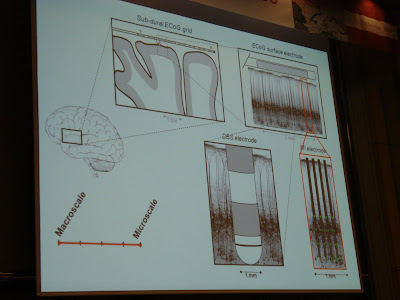


I said something as soon as I could during Q&A. Clearly this was rewarding brain stimulation, strong hedonic pleasure. But didn't Schlaepfer and others report that DBS to the accumbens does not produce liking or any potential for addiction? Okun lit up, the whole issue was fascinating he said. Said they'd had no idea they'd see these behavioural responses when they began operating, but it was definitely eurphoria they were seeing. In fact, mania was occasionally a problem, one patient had stayed up all night once painting her house, ceilings and all. In those cases doctors faced the tricky choice of medicating the mania or reducing current strenght and risking the return of OCD.
I asked him again when the session was over: Had he heard my talk or seen my poster? Did he know that the euphoric deep brain stimulation response had been used as a reinforcer to motivate exercise and problem solving in rats? What did he think about applying the same method to human patients, say obese patients who need exercise? And he tells me they're working on it, they've talked about it, they've even tried electrical reward during learning trials. Said he didn't think anything had been published yet and that it wasn't his project, but gave me his card and said he'd put me in touch with the right people.
Those of you who voted '2010', you may be right.
27 Sep 2009 edit
A misunderstanding - the people in question turned out to be working on using reward signals FROM the brain to improve implant software performance, not reward signals TO the brain to improve HUMAN performance, which is what the iPlant is about.
15:59. I was so tired this morning I put both contacts in one eye.. Spent the whole morning thinking I had weird goo in my eyes blurring my vision. Arriving at the conference centre I figured 'ah! I must have forgot to put a contact in one eye'. Indeed, the left eye was naked in the mirror and I put a reserve in. Spent the day, vision still blurry, wondering if I'd caught swine flu and would go blind. Only realized my mistake as I was leaving and went to take them out and whaddayaknow, two little contacts making love on my right lens.


12 September 2009
At the International Neuromodulation Society conference in Seoul 2
05.40. Lesson 1: if you're flying east and have to be up at 5 local time the second morning, do give yourself more than two days to re-set your bodyclock. got maybe 4 hrs sleep. should be interesting. shit. on a train now, practising the talk and wondering whether there really will be 'continental breakfast' at the conference centre.
10.02. The conference is small compared to SfN of course. Maybe 200-250 people here, not enough to fill either of the two 400 seat conference halls where all talks take place. However! There's free coffee and excellent food! And comfy tables in front of the chairs in the conference halls. There's another big hall packed with mammoth booths by Medtroic, St Jude Neuromodulation, Boston Scientific etc. St Jude serves good coffee.


10.02. The conference is small compared to SfN of course. Maybe 200-250 people here, not enough to fill either of the two 400 seat conference halls where all talks take place. However! There's free coffee and excellent food! And comfy tables in front of the chairs in the conference halls. There's another big hall packed with mammoth booths by Medtroic, St Jude Neuromodulation, Boston Scientific etc. St Jude serves good coffee.


11 September 2009
At the International Neuromodulation Society conference in Seoul
10.42. Arrived in South Korea yesterday and bussed in to Seoul. They have pine trees here! I guess Russia is just around the corner. Temperature's perfect but the sky's cloudy. Went for a walk around downtown Seoul last night. Lots of neon. Big streets and buildings but not crazy big like Singapore, tho maybe closer to the city centre. I'm a sucker for huge modern buildings.
I'm here to present a poster and give a talk about the iPlant project at the 9th world conference of the International Neuromodulation Society. They're footing the bill. Truth be told I'm not sure what I'm doing here.
16:57. Woke up early and spent the day roaming around north-western Seoul. Still not huge or very rich, just very big and active, lots of cars, lots of people. Took forever to find the conference centre. Spent half an hour hiking up a hill at one point and was greeted by a dead end and a very helpful man who spoke no english. Didn't have a proper map and Google maps sucks here (probably wants korean characters, luckily the trains write and speak english). Got to see a lot though, and take pictures. People differences include sleeping (sitting up) on the train, and quite a few wearing face masks. My hotel (Imperial Palace Hotel) is great, with one caveat: they charge for internet. No internet at the conference centre (Grand Hilton Hotel) either. Sucks. Should paradoxically leave more time for me to blog and make videos though.
I've gone through my talk a few times and will try to record it tonight. Poster presentation and talk tomorrow. Poster needs to be up at 7 and the trip to the conference centre takes 1.5 hrs. Uff. Main concern is I need to not get stage-fright, there will be enough confusion re this project without me adding to it. Seriously, they've squeezed me in between 'Motor Cortex Stimulation for Central Pain and Peripheral Neuropathic Pain' and 'Long term Follow-up in Vagal Nerve Stimulation for Drug-Resistant Epileptic Patients' and put an MD next to my name. Should be interesting.
Have a good day.


I'm here to present a poster and give a talk about the iPlant project at the 9th world conference of the International Neuromodulation Society. They're footing the bill. Truth be told I'm not sure what I'm doing here.
16:57. Woke up early and spent the day roaming around north-western Seoul. Still not huge or very rich, just very big and active, lots of cars, lots of people. Took forever to find the conference centre. Spent half an hour hiking up a hill at one point and was greeted by a dead end and a very helpful man who spoke no english. Didn't have a proper map and Google maps sucks here (probably wants korean characters, luckily the trains write and speak english). Got to see a lot though, and take pictures. People differences include sleeping (sitting up) on the train, and quite a few wearing face masks. My hotel (Imperial Palace Hotel) is great, with one caveat: they charge for internet. No internet at the conference centre (Grand Hilton Hotel) either. Sucks. Should paradoxically leave more time for me to blog and make videos though.
I've gone through my talk a few times and will try to record it tonight. Poster presentation and talk tomorrow. Poster needs to be up at 7 and the trip to the conference centre takes 1.5 hrs. Uff. Main concern is I need to not get stage-fright, there will be enough confusion re this project without me adding to it. Seriously, they've squeezed me in between 'Motor Cortex Stimulation for Central Pain and Peripheral Neuropathic Pain' and 'Long term Follow-up in Vagal Nerve Stimulation for Drug-Resistant Epileptic Patients' and put an MD next to my name. Should be interesting.
Have a good day.


Subscribe to:
Posts (Atom)